




Why You Can't Stick to a Diet (And How to Fix It Without Starving)
The main reason people cannot stick to a diet is not a lack of willpower; it is because strict diets trigger your brain's evolutionary threat response. When you follow rules that require extreme calorie restriction, long fasting windows, or intense workouts, your mind views this as an unsafe famine. To protect you, your brain activates "outdated mental scripts" - cognitive shortcuts designed to drive intense hunger, lower your baseline energy, and push you toward comfort foods.
To break the cycle and build long-term consistency, you must update these mental scripts through three steps:
1. Identify the Outdated Script: Recognise that old rules, like "I must suffer to lose weight" are just mental shortcuts formed from past diet attempts.
2. Run a Minimum Effective Dose Experiment: Test small, non threatening daily actions, such as eating regular meals or taking a 5 minute walk, that gather real world proof of progress without triggering anxiety.
3. Shift to Outcome-Based Decision Making: Use feedback from your own body, like improved digestion, higher energy, and reduced cravings, to build flexible, lasting habits instead of relying on rigid, temporary diet rules.
Why You Can't Stick to a Diet (And How to Fix It for Good)
If you have ever started a new nutrition program on Monday with total determination, only to find yourself searching for snacks by Thursday night, you know how soul-destroying it feels.
After trying program after program, it is easy to blame yourself. You might ask: "Why can't I stick to a diet like everyone else?" or assume that you simply lack self-discipline.
Here is the truth: your inability to stick to a rigid plan is not a personal failure.
Your brain is simply doing what it was designed to do—using outdated mental scripts to protect you from perceived threat. When you understand how your mind forms these internal rules, you can stop fighting yourself and build an approach to health that feels effortless.
What Is a Mental Script? (Your Brain's Internal Operating System)
Your brain is constantly processing vast amounts of information every single second. To prevent complete mental overload, it creates automatic shortcuts known as mental scripts or internal maps.
Think of a mental script like a simple drawing of a city:
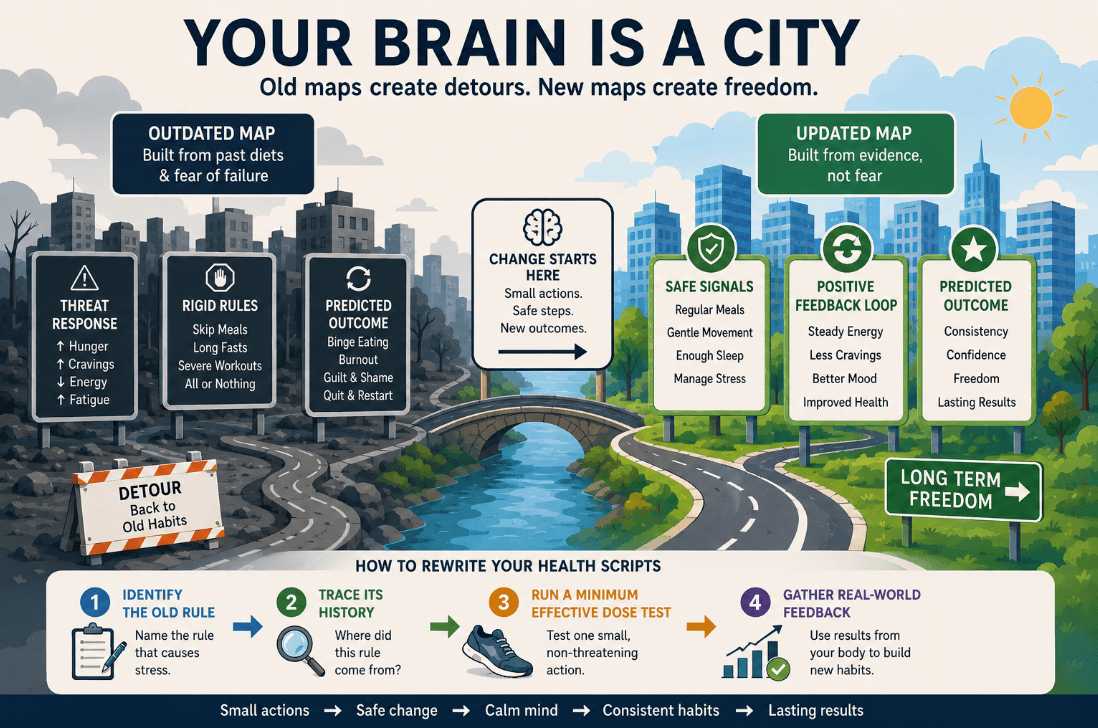
A map is not the actual city itself, but it helps you navigate streets without getting lost. In the same way, your brain uses past experiences to build rules about how the world works.
These internal scripts help you perform basic daily tasks:
They help you predict what will happen next without needing to overthink.
They allow you to connect new information to things you already know.
They store past memories so you don't have to relearn basic skills every morning.
However, when it comes to health, many of us are trying to navigate modern life using old, broken maps.
Why Your Mind Naturally Resists Strict Dieting
To understand why traditional diets fail, you have to look at how your brain evolved over thousands of years.
Your mind operates with a built-in negativity bias—a survival mechanism designed to scan for danger, expect the worst-case scenario, and keep you safe from harm.
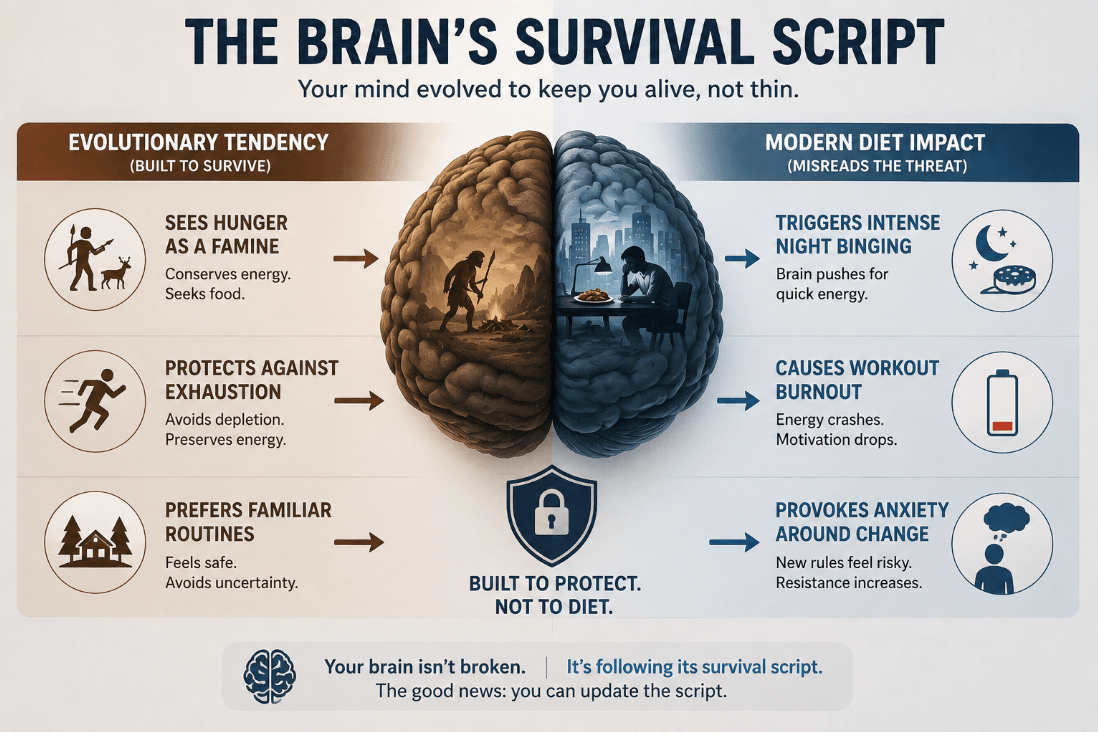
When you start an aggressive diet—skipping meals, drinking shake replacements, or doing exhausting workouts—your brain does not say, "Great, we are getting healthier!"
Instead, it panics. It interprets extreme restriction as a physical threat, sending strong biological signals that force you to stop:
It ramps up appetite hormones to push you toward quick energy.
It slows down your baseline energy burn to conserve resources.
It creates mental resistance, making strict rules feel completely unbearable.
This is why severe restriction inevitably leads to evening overeating or total abandonment of the plan. Your brain is not failing; it is actively keeping you alive.
How We Form Our Health Rules
Most people carry rigid health rules without ever stopping to question where they came from. Typically, our internal scripts are built in three distinct ways:
1. Direct Personal Experience (N=1 Self-Data)
If you once lost weight quickly on an extreme fasting regime—only to gain it back later—your brain still recorded the initial drop. It created a script: "To lose weight, I must stop eating for long stretches." Even if that rule causes severe acid reflux or night-time binges today, your mind holds onto it because it feels familiar.
2. Borrowed Rules from "Authority Figures"
From childhood, we absorb rules directly from parents, teachers, magazines, or social media fitness influencers.
Just because a health guru has thousands of followers or speaks with total confidence does not mean their specific rules are safe, effective, or appropriate for your unique body.
3. Conscious Personal Choices
This happens when you look at clear, calm evidence and make a decision based on what actually helps you feel good—like choosing to go to bed earlier to improve your morning energy.
The Biopsychosocial View: Why Standard Diets Fail
A major reason generic meal plans fail is that they treat health as a simple math equation: calories in versus calories out.
Real health is much more complex. This is why leading coaching frameworks use a biopsychosocial perspective, evaluating how three distinct areas of your life interact:
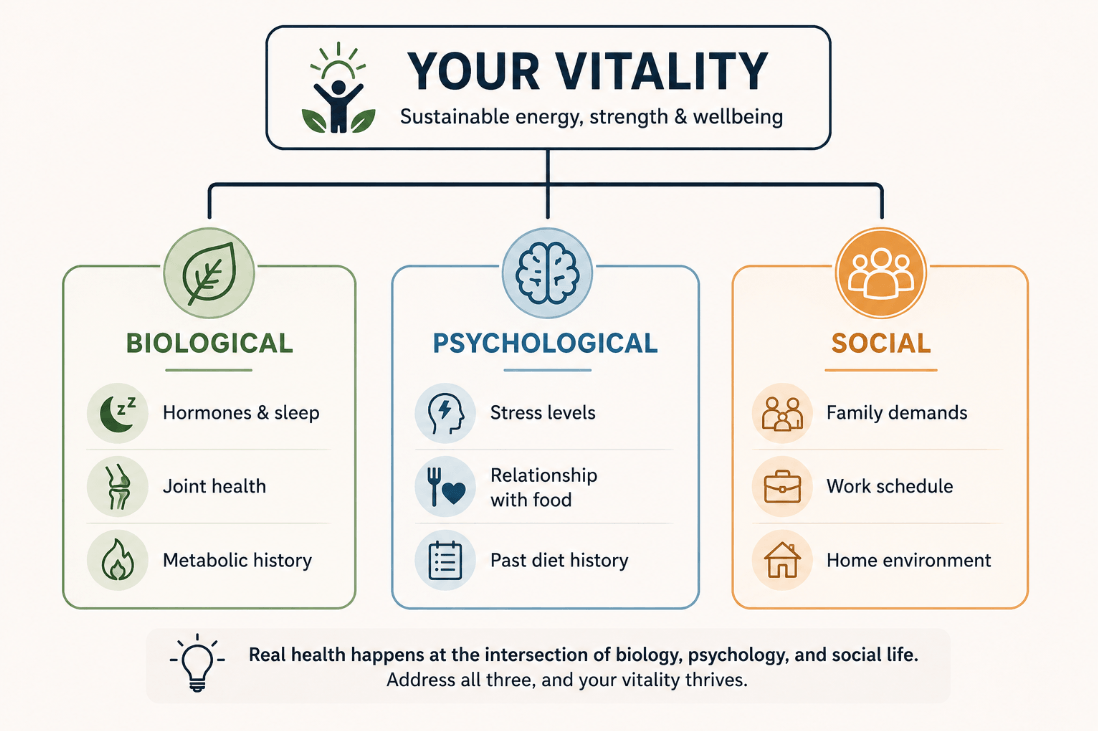
If a plan only looks at the biology while ignoring your work stress, family mealtime, or past emotional relationship with food, it creates friction. That friction is why sticking to a standard diet feels so hard.
🛠️ Coaching Toolkit: How to Rewrite Your Health Scripts
If you are ready to break free from the cycle of starting and stopping, use this step-by-step coaching framework to update your mental rules.
Step 1: Identify the Old Rule
Write down the single rule that causes you the most stress. Examples:
"I must never eat after 6 PM,"
"If I don't workout for an hour, it doesn't count."
Step 2: Trace its History
Ask yourself: Where did I first learn this rule? Did I pick it up from a fad diet, a parent, or a past program that left me feeling exhausted?
Step 3: Run a Minimum Effective Dose (MED) Test
Instead of forcing a major lifestyle overhaul, test a tiny, non-threatening daily action. Example:
If you believe you need an hour of intense exercise to see progress, test a 5-minute daily walk for one week.
Step 4: Gather Real-World Feedback
Pay attention to how your body responds to the test.
Did the 5-minute walk leave you feeling energized instead of wiped out?
Did eating regular, balanced meals reduce your evening sugar cravings?
When you collect calm, positive data from your own body, your brain learns that change is safe. The old threat response drops away, allowing lasting consistency to take its place.
📝 Your Personal Reflection: Building Your Personal Manual
Use these three prompts in a journal or notes app to start updating your personal health scripts:
What is one belief or rule about dieting that you used to follow, but now realize is unhelpful?
(Example: "I used to think skipping breakfast was the only way I could control my weight.")
What past experience or diet program created that rule in your mind?
(Example: "I did an aggressive fasting routine a few years ago that left me constantly hungry and dealing with acid reflux.")
What small, daily habit could you test this week to prove to your brain that health can feel gentle and supportive?
(Example: "I can eat three predictable, balanced meals each day and track how my afternoon energy improves.")
Final Thoughts
You do not need more willpower, stricter rules, or harsher punishment to reach your health goals.
By replacing rigid diet rules with simple, low-stress daily habits, you quiet your nervous system, protect your energy, and create results that last for the rest of your life.
Stop fighting your own evolution, and forcing yourself to follow generic diet rules designed for 20 year olds. In just 15 minutes, we’ll map out what your unique body actually needs to thrive, so you can have better health, end evening cravings, and build steady, daily energy without giving up the foods you love.
On this quick, relaxed call, we will:
Identify your #1 habit leak: Pinpoint the exact hidden trigger causing your energy crashes or diet burnout.
Draft action plan using my GSPA framework: Create a simple, low-stress blueprint tailored to your schedule, health history, and goals.
Clear the confusion: Get expert answers to your biggest health questions.
Click The Button to Apply For Your Free 15-Minute Strategy Call:
Just so you know, you're in good company...
See What Naomi and Jakob have to say about online weight loss coaching:

Before working with Nico, I'd spent around ten years trying different diets and exercise plans. Every approach was extreme in one way or another. I'd stick to it for a month or two, but eventually I'd realise I couldn't live like that.

Jakob
Dentist
The most effective and life-changing health experience I’ve had. With Nico’s help and guidance I’ve improved my mobility, lost weight, redefined my relationship with food and started making the right health and well-being choices.

Naomi
Finance Professional
Reliable Health Insights, Expert Lifestyle Guidance, Updates, Tools, and Valuable Resources.


Stay informed with valuable health and wellness tips delivered straight to your inbox.
By submitting your details, you understand that you will be sent information by email, and you give permission to receive email communication. Your details will never be shared, and you can unsubscribe by clicking the unsubscribe link at the bottom of any email. Disclaimer: By using this website you agree that it is your responsibility to work directly with your health care provider before, during, and after seeking nutrition and / or fitness consultation. Any information provided is not to be followed without prior approval of your doctor. If you choose to use this information without such approval, you agree to accept full responsibility for your decision. *Results vary from person to person. Please read the privacy policy here.
Contact:
One Habit Coaching
2 Goat Street,
Haverfordwest,
Pembrokeshire,
SA611PX,
UK
07983342824