




Why Do I Feel So Unmotivated and Tired? (The Food & Brain Connection)
When you feel low in energy, unmotivated, or constantly anxious, it is often not a lack of willpower. Your brain relies on key chemicals called neurotransmitters (like dopamine and serotonin) to keep you feeling happy, motivated, and calm.
If you aren't eating enough protein, healthy omega-3 fats, and colourful plant foods, your brain lacks the raw building blocks it needs to produce these brain chemicals.
To restore your brain's natural energy without restrictive dieting, focus on four key nutrition actions:
1. Eat Enough Protein: Protein provides amino acids that build dopamine (motivation) and serotonin (calm and mood).
2. Get Healthy Omega-3 Fats: Found in oily fish, algae, or seeds, omega-3s act like oil for your brain's communication pathways.
3. Eat Colourful Fruits & Vegetables: Bright plant foods supply vitamins and minerals that shield your brain from fatigue.
4. Support Your Gut Health: High-fiber foods nourish your gut microbiome, which sends calm signals straight to your brain.
Why Do I Feel So Unmotivated and Tired?
How Food Affects Brain Fog Mood And Motivation
Have you ever woken up feeling completely "blah," flat, or lacking the drive to get through your day?
You want to feel energised, stay on top of your routine, and make healthy choices. But instead, you feel constantly tired, irritable, anxious, or plagued by brain fog. When you try to force yourself to "be motivated," your mind just feels resistant and stuck.
It is easy to blame yourself and think: "What is wrong with me? Why can't I just pull myself together?"
Here is the reassuring truth: feeling flat and unmotivated is not a willpower problem - it is a brain chemistry problem. When your diet lacks basic nourishment, or when you've been following strict diets that restrict key foods, your brain loses the raw materials it needs to make "feel-good" chemicals.
By giving your body a few simple food building blocks, you can naturally lift brain fog, stabilize your mood, and feel like yourself again.
Your Brain's Fuel: How Food Builds Your Mood And Motivation
Think of your brain like a high performance engine. It relies on chemical messengers called neurotransmitters to run smoothly. These chemicals control how you think, feel, sleep, and handle stress.
Where does your brain get the materials to make these chemicals? Directly from the food you eat!
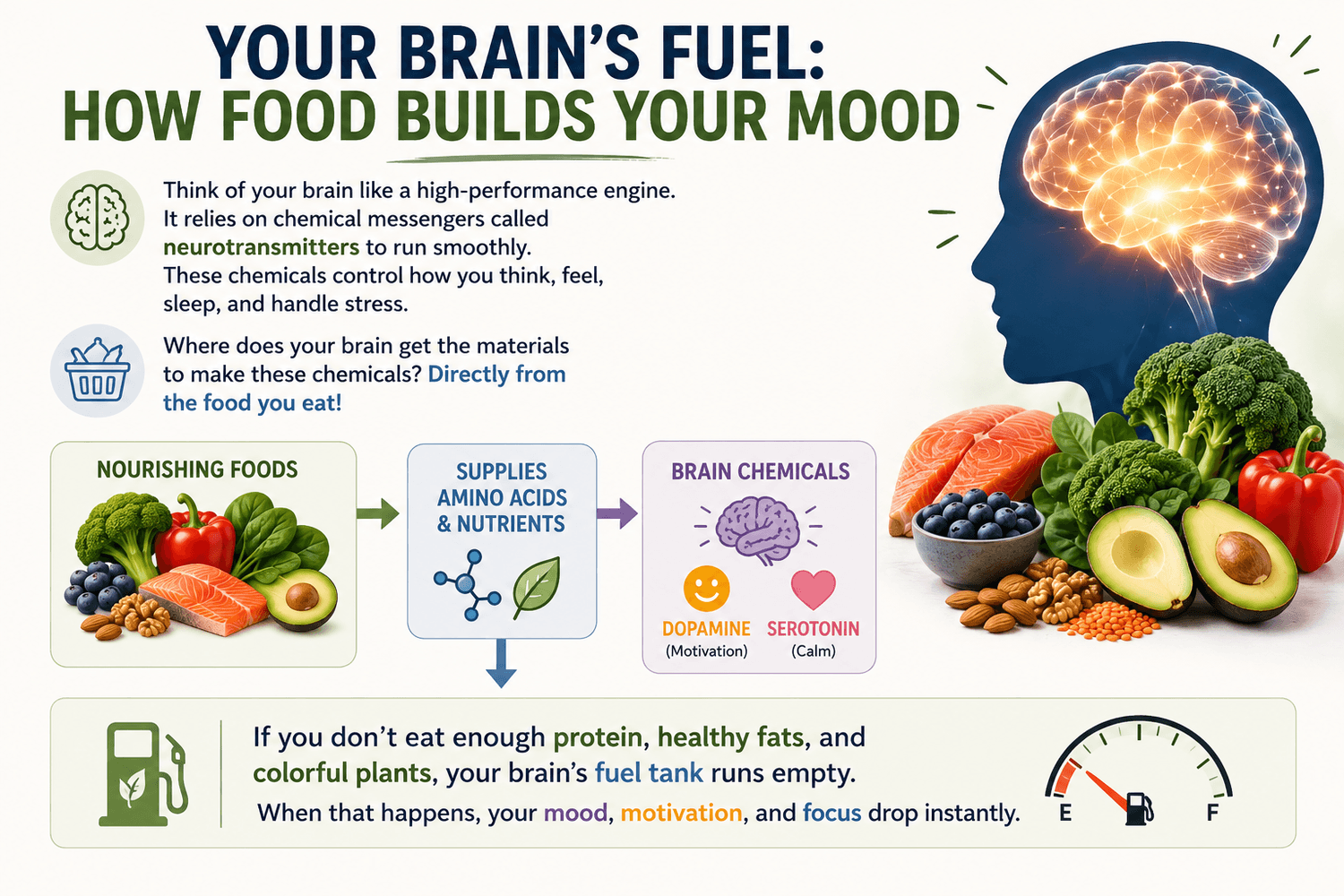
If you don't eat enough protein, healthy fats, and colourful plants, your brain's fuel tank runs empty. When that happens, your mood, motivation, and focus drop instantly.
What Happens When Your Brain Is Missing Fuel?
What Happens When Your Brain Is Missing Fuel? When key brain chemicals drop too low, it changes how you experience daily life. Look at this simple table to see how a lack of brain nutrients shows up in your body:
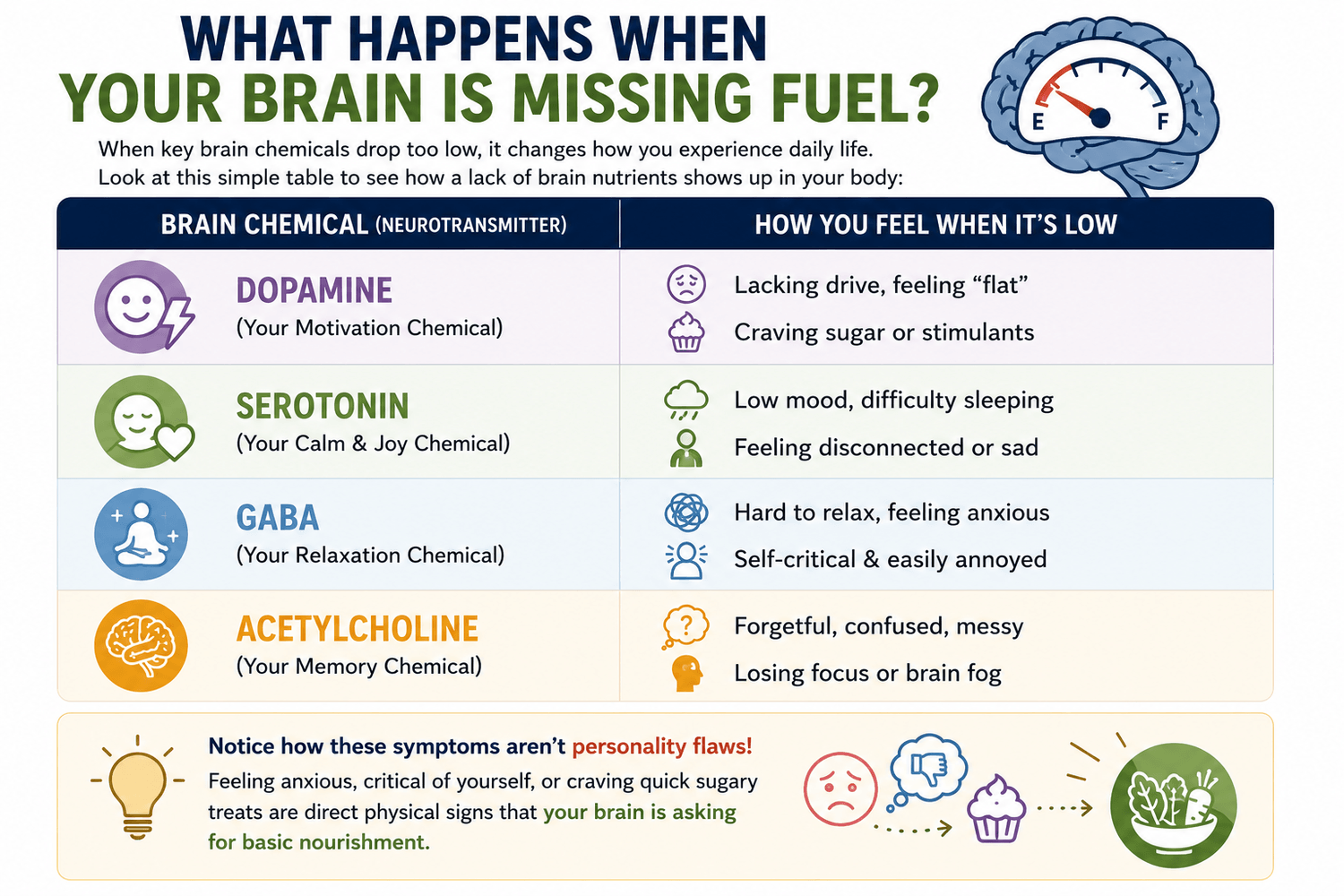
Notice how these symptoms aren't personality flaws! Feeling anxious, critical of yourself, or craving quick sugary treats are direct physical signs that your brain is asking for basic nourishment.
⚠️ The Common Mistake: Cutting Food When You Feel Tired
When people feel demotivated or notice the scale creeping up, their first reaction is often to slash calories in half or go on a strict diet. This is the biggest trap you can fall into:
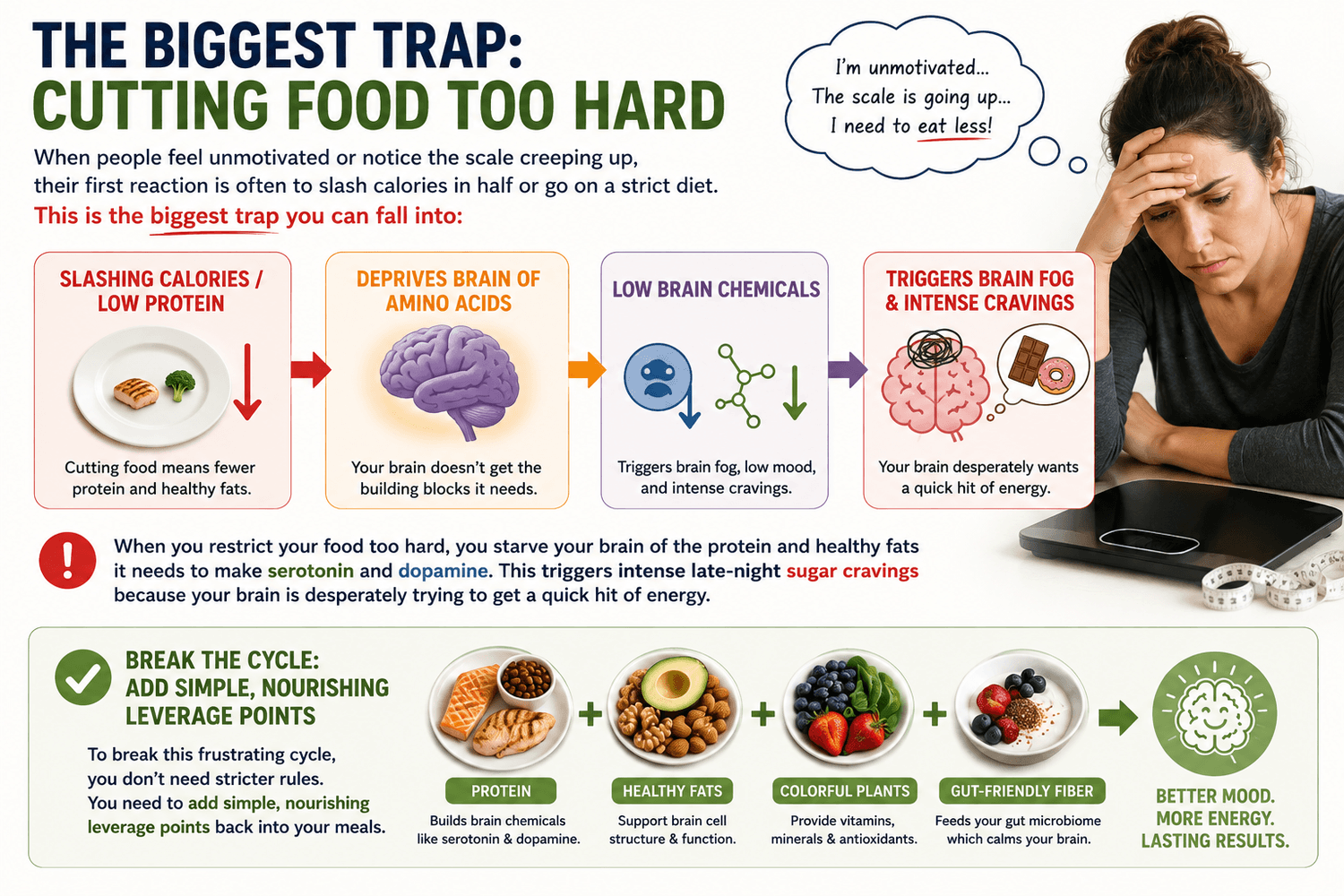
When you restrict your food too hard, you starve your brain of the protein and healthy fats it needs to make serotonin and dopamine. This triggers intense late night sugar cravings because your brain is desperately trying to get a quick hit of energy.
To break this frustrating cycle, you don't need stricter rules. You need to add simple, nourishing leverage points back into your meals.
The 4 "Brain Leverage Points" for Daily Energy
A leverage point is a small nutrition change that creates a huge improvement in how you feel. Here are four simple ways to feed your brain every day:
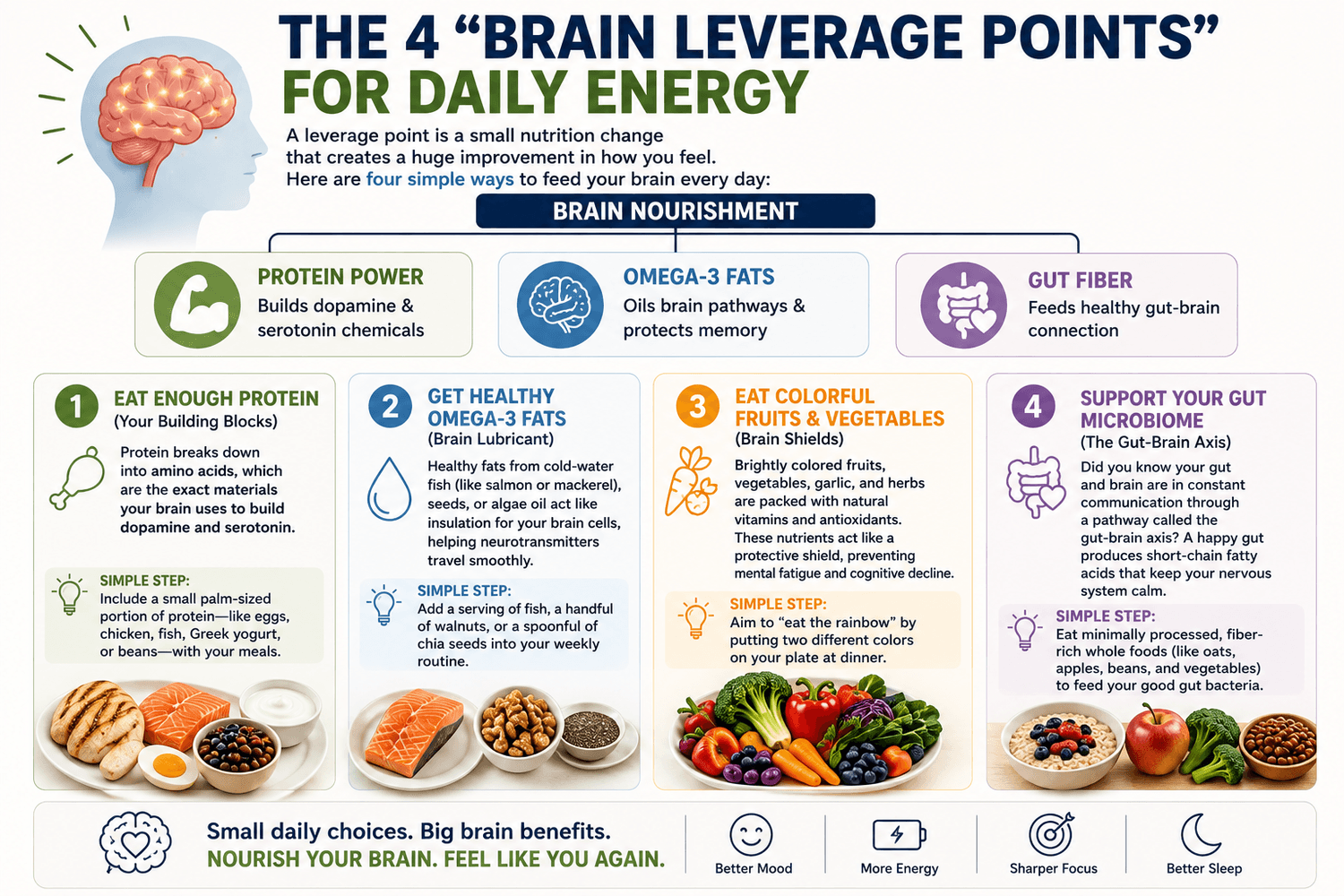
1. Eat Enough Protein (Your Building Blocks)
Protein breaks down into amino acids, which are the exact materials your brain uses to build dopamine and serotonin.
Simple Step: Include a small palm sized portion of protein - like eggs, chicken, fish, Greek yogurt, or beans - with your meals.
2. Get Healthy Omega-3 Fats (Brain Lubricant)
Healthy fats from cold-water fish (like salmon or mackerel), seeds, or algae oil act like insulation for your brain cells, helping neurotransmitters travel smoothly.
Simple Step: Add a serving of fish, a handful of walnuts, or a spoonful of chia seeds into your weekly routine.
3. Eat Colourful Fruits & Vegetables (Brain Shields)
Brightly coloured fruits, vegetables, garlic, and herbs are packed with natural vitamins and antioxidants. These nutrients act like a protective shield, preventing mental fatigue and cognitive decline.
Simple Step: Aim to "eat the rainbow" by putting two different colours on your plate at dinner.
4. Support Your Gut Microbiome (The Gut-Brain Axis)
Did you know your gut and brain are in constant communication through a pathway called the gut-brain axis? A happy gut produces short-chain fatty acids that keep your nervous system calm.
Simple Step: Eat minimally processed, fiber-rich whole foods (like oats, apples, beans, and vegetables) to feed your good gut bacteria.
🛠️ Your 3-Step "Brain Boost" Meal Checklist
You don't need a complicated diet plan to start feeling clearer and more motivated today. Use this simple checklist at your next meal:
Step 1: Check Your Protein Base
Ask yourself: "Where is the protein on my plate?"
Quick Fix: Add an egg to your breakfast, a cup of Greek yogurt to your snack, or chicken/beans to your salad.
Step 2: Add a Splash of Colour
Ask yourself: "Is there something colourful or fresh here?"
Quick Fix: Throw a handful of berries into your oats, or add fresh spinach and tomatoes to your lunch.
Step 3: Keep It Whole and Simple
Choose real, minimally processed whole foods over packaged snacks whenever possible. Whole foods give your brain steady, calm energy without the sugar crash.
📝 Personal Reflection: How Does Your Brain Feel?
Take two minutes to answer these simple questions in a notebook or on your phone:
1. Which low-brain-chemical feeling do you struggle with the most right now?
(Example: Feeling "flat" and lacking motivation around 3:00 PM, or feeling anxious and self-critical at night.)
2. When you look at your usual meals, which brain fuel is missing the most?
(Example: I rarely eat enough protein during breakfast, or I skip eating fruits and vegetables when I'm busy.)
3. What is one simple food item you can add to your grocery list this week to support your brain?
(Example: Buying a tub of Greek yogurt for a quick morning protein boost.)
Final Thoughts
Feeling exhausted, unmotivated, or flat is not something you just have to accept. By giving your body and brain the simple nutrients they need - protein, healthy fats, fibre, and colourful plant foods—you restore your feel-good chemicals naturally. You don't need extreme willpower when your brain is properly fuelled!
Stop fighting your own evolution, and forcing yourself to follow generic diet rules designed for 20 year olds. In just 15 minutes, we’ll map out what your unique body actually needs to thrive, so you can have better health, end evening cravings, and build steady, daily energy without giving up the foods you love.
On this quick, relaxed call, we will:
Identify your #1 habit leak: Pinpoint the exact hidden trigger causing your energy crashes or diet burnout.
Draft action plan using my GSPA framework: Create a simple, low-stress blueprint tailored to your schedule, health history, and goals.
Clear the confusion: Get expert answers to your biggest health questions.
Click The Button to Apply For Your Free 15-Minute Strategy Call:
References
Khanna P, Chattu VK, Aeri BT. Nutritional Aspects of Depression in Adolescents - A Systematic Review. Int J Prev Med. 2019 Apr 3;10:42.
Chong TT-J. Updating the role of dopamine in human motivation and apathy. Current Opinion in Behavioral Sciences. 2018 Aug 1;22:35–41.
Bazinet RP, Metherel AH, Chen CT, Shaikh SR, Nadjar A, Joffre C, et al. Brain eicosapentaenoic acid metabolism as a lead for novel therapeutics in major depression. Brain Behav Immun. 2020 Mar;85:21–8.
Patch CS, Hill-Yardin EL, Ryan L, Daly E, Pearce AJ. Long chain omega-3 fatty acid intervention in ageing adults at risk of dementia following repeated head trauma. The Journal of Prevention of Alzheimer’s Disease. 2021;8(1):29–32.
Chiu H-F, Venkatakrishnan K, Wang C-K. The role of nutraceuticals as a complementary therapy against various neurodegenerative diseases: A mini-review. Afr J Tradit Complement Altern Med. 2020 Sep;10(5):434–9.
Tong J, Satyanarayanan SK, Su H. Nutraceuticals and probiotics in the management of psychiatric and neurological disorders: A focus on microbiota-gut-brain-immune axis. Brain Behav Immun. 2020 Nov;90:403–19.
Martínez García RM, Jiménez Ortega AI, López Sobaler AM, Ortega RM. [Nutrition strategies that improve cognitive function]. Nutr Hosp. 2018 Sep 7;35(Spec6):16–9.
Lang UE, Beglinger C, Schweinfurth N, Walter M, Borgwardt S. Nutritional aspects of depression. Cell Physiol Biochem. 2015 Sep 25;37(3):1029–43.
Just so you know, you're in good company...
See What Naomi and Jakob have to say about online weight loss coaching:

Before working with Nico, I'd spent around ten years trying different diets and exercise plans. Every approach was extreme in one way or another. I'd stick to it for a month or two, but eventually I'd realise I couldn't live like that.

Jakob
Dentist
The most effective and life-changing health experience I’ve had. With Nico’s help and guidance I’ve improved my mobility, lost weight, redefined my relationship with food and started making the right health and well-being choices.

Naomi
Finance Professional
Reliable Health Insights, Expert Lifestyle Guidance, Updates, Tools, and Valuable Resources.


Stay informed with valuable health and wellness tips delivered straight to your inbox.
By submitting your details, you understand that you will be sent information by email, and you give permission to receive email communication. Your details will never be shared, and you can unsubscribe by clicking the unsubscribe link at the bottom of any email. Disclaimer: By using this website you agree that it is your responsibility to work directly with your health care provider before, during, and after seeking nutrition and / or fitness consultation. Any information provided is not to be followed without prior approval of your doctor. If you choose to use this information without such approval, you agree to accept full responsibility for your decision. *Results vary from person to person. Please read the privacy policy here.
Contact:
One Habit Coaching
2 Goat Street,
Haverfordwest,
Pembrokeshire,
SA611PX,
UK
07983342824